NEWS | SOFTWARE | SHEET
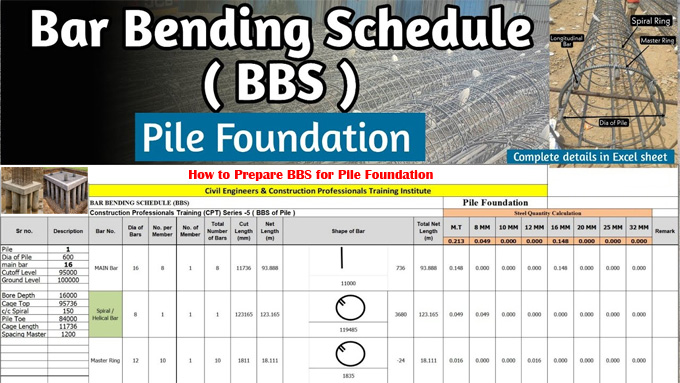
Bar Bending Schedule for Pile Foundation with Calculations
The Bar Bending Schedule (BBS) refers to the chart, in which type, size, number and length of the reinforcement bars are listed that are required for the specific structural element. The Bar Bending Schedule (BBS) helps to provide detailed insight about how the steel reinforcements should be cut, bent and placed. The Bar Bending Schedule (BBS) helps to ensure that the structural load has been transferred properly from the construction structure to the foundation.
Discuss the key components of the BBS for Pile Foundation
Several components need to be considered while designing BBS for pile foundation, which are as follows:
Types of piles
It's needs to consider that different types of pile, including driven piles, bored piles, or screw piles, have specific reinforcement requirements.
Details of rebar
Information about the rebars, including the shape, diameter and length, should also be kept in mind while designing BBS for pile foundation.
Concrete cover requirements
The concrete cover also needs to be included to protect the steel from corrosion.
Length of the lap and anchorage
The overlap of the bars is required to ensure the transfer of the proper load.
Why is the BBS important for pile foundation?
Helps to ensure accuracy
A well-prepared BBS has been prepared to eliminate the errors in cutting and bending, which helps to get more precise reinforcement.
Improve cost efficiency
BBS helps to accurately estimate the amount of steel required, which minimises the wastage, as well as reducing the costs accurately.
Maintain structural integrity
The BBS helps to provide detailed bars, which ensure that the pile foundation can bear the intended load, and thus helps to provide safety and stability to the construction structure.
How to prepare BBS for pile foundation?
To prepare the Bar Bending Schedule (BBS) for the pile foundation, several steps need to be followed, which are as follows:
Understanding the structural drawings
At first of designing a BBS, the structural drawings should be reviewed properly provided by the engineers. The structural drawing includes the load-bearing requirements, details on the dimensions and the type of reinforcement that is required.
Calculating the length of the rebars
In the next step, the required length of the rebars needs to be calculated. In this context, the full depth of the pile needs to be calculated. In the case of the circular piles, the length has been calculated on the basis of the diameter and spacing specified in the design. Stirrups are used in the top sections of the piles, which helps to provide additional shear strength.
Estimating the number of rebars
The number of rebars needed for each section of the pile foundation. This estimation process has been done on the basis of the spacing that has been provided in the design drawings.
Bar cutting and bar-bending process
After determining the length and quantities of the rebars, they need to be cut and bent on the basis of the design specifications. This bar cuttinga nd bending process should be done precisely to avoid any kind of errors that lead to structural issues in the foundation structure.
Preparing the BBS chart
In the next step, all data should be compiled into a BBS chart. This BBS chart should include the following:
- A bar mark, which acts as the identifier for each type of rebar.
- The bar shape codes, as per the standard codes.
- The diameter of the rebar should be in millimetres.
- The total length of the rebar should be included in the BBS chart.
- The number of rebars should be included in the BBS chart.
- The weight of the steel rebars should also be mentioned in the BBS chart. In this context, the weight of the rebar should be calculated by following this formula:
Weight = Length x Unit Weight
Checking for compliance with standards
It needs to be ensured that the BBS complies with the relevant building codes and standards. Thus, it has been ensured that the pile foundation will meet all safety requirements of the construction structure.
Understanding the key advantages of the well-prepared BBS for pile foundation construction
Improving construction efficiency
By preparing the well-prepared BBS, the construction workers can cut and bend bars quickly and more accurately, which helps to reduce the labour time.
Improving structural safety
A well-prepared BBS helps to minimise the steel wastage, which helps to ensure that only the required amount has been used.
Cost-saving feature
A well-prepared BBS helps to reduce wastage, as well as helps to optimise labour, thus the overall construction cost has been significantly reduced.
Material optimisation feature
The BBS also helps to provide correctly reinforced piles, which helps ot ensure that the pile foundation can handle the loads imposed by the construction structure.