NEWS | SOFTWARE | SHEET
Loads and Forces Acting on Retaining Wall and Their Calculations
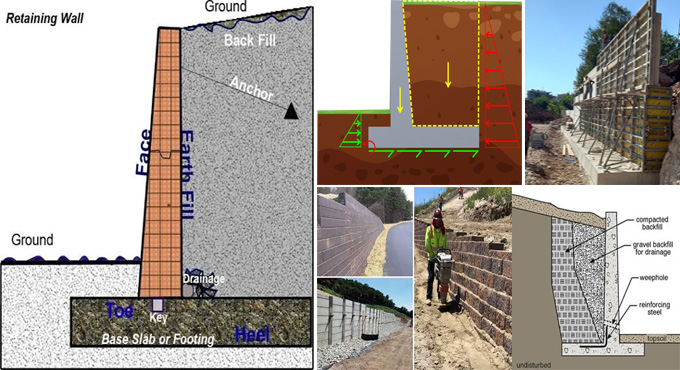
Different types of loads and forces have been acting on the retaining wall, which needs to be calculated accurately for designing the retaining wall. These types of forces on the retaining wall depend upon multiple factors. The design of the retaining wall includes any of the forces that have been explained in the following sections:
Lateral earth pressure
The retaining wall has been constructed with the aim of retaining the soil; as a result, the soil lateral earth pressure is the major concern in the design of the retaining wall. In this case, the sliding soil wedge theory is the basis for most of the theories through which the lateral earth pressure has been computed. The sliding soil wedge theory suggests that a triangular wedge of soil will slide down whether the retaining wall has been removed suddenly, and the retaining wall has to sustain this edge soil.
Axial loads
The axial forces provide overturing resistance on the retaining walls. The axial forces can be of different types, including vertical loads on the stem, structural weight, soil weight and vertical component of active pressure.
- The vertical loads have occurred from the beam reactions, lodgers, or bridges, which have been directly applied to the stem. In critical conditions, it is not important to consider live load from dead load separately, as the increase of the axial live load on the stem is resisting moments. The point vertical loads on the retaining wall have been considered to be spread downward in a slope of two vertical to one horizontal.
- The soil weight loads refer to the weight of the soil above the toe and heel of the retaining wall.
- The structural load refers to the weight of the footing and stem, which has been added to the soil load-bearing pressure and provides stability against overturning and sliding.
- The vertical component of active pressure refers to the resultant earth pressure action line at an angle from the horizontal. This angle is equal to the angle of the backfill slope.
Surcharge loads
Surcharge loads refer to the additional vertical loads that act on the retaining wall, which have been applied to the backfill soil above the top of the retaining wall. The surcharge loads can be either dead loads or live loads, which have been obtained from parking or highway lots, paving or adjacent footings.
The live load surcharge has been considered while the vehicular action acts on the backfill soil surface at a distance, which is equal to or less than the height of the retaining wall from the wall back face. Different types of surcharge forces act on the retaining wall, including highway surcharges, adjacent footing surcharges, and backfill compaction surcharges.
Impact forces
It is important to design the retaining wall for the car bumper when the wall extends above grade, and the parking space is close to it. In the case of designing the retaining wall for the impact loads, the stem should be examined at equally spaced points along the stem length, as the impact force spreads over a greater length of the stem. In this case, the slope of the two vertical to one horizontal needs to be used for spreading impact forces.
Apart from these forces, another two forces act on the retaining wall, which are Seismic earth pressure and Seismic wall self-weight forces.
Wind on the projecting stem
Wind pressure can also generate an overturning force on the retaining wall while it has been exposed and extends above grades.
Learn about Surcharge
Surcharge is the load that has been applied to the soil behind a retaining wall. The surcharge load has come from different types of sources, for example, traffic, adjacent foundations, parked vehicles, construction equipment, material stockpiles or any material behind the wall, in addition to the retained soil. Groundwater also leads to additional pressure on the retaining wall, but it does not refer to the surcharge. The stability and performance of the retaining wall have been impacted by the presence of the surcharge.
So, it is important to account for the surcharge loads during the design and construction process. To calculate the corresponding lateral pressure on the retaining walls, the surcharge has been classified into different types, which are as follows:
- Uniform surcharge load
- Strip load
- Point load
- Line load
- Uniform rectangular load
- Horizontal load
- Pile axial load
Understanding the point load surcharge on the retaining wall
Point load surcharge refers to those loads, like isolated footings from adjacent structures and outrigger loads from a crane or concrete pump. A wheel load from a concrete truck has also been considered as the point load while the concrete truck is adjacent to the retaining wall or shoring and in the process of uploading.
In this case, the truck could be positioned either perpendicular or parallel to the retaining wall. Any kind of load has been approximated by a point load or a superposition of several point loads. In this case, a higher accuracy for the corresponding lateral earth pressure needs more point loads in the approximation.