NEWS | SOFTWARE | SHEET
Discuss the Advantages and Disadvantages of Precast Concrete Piles
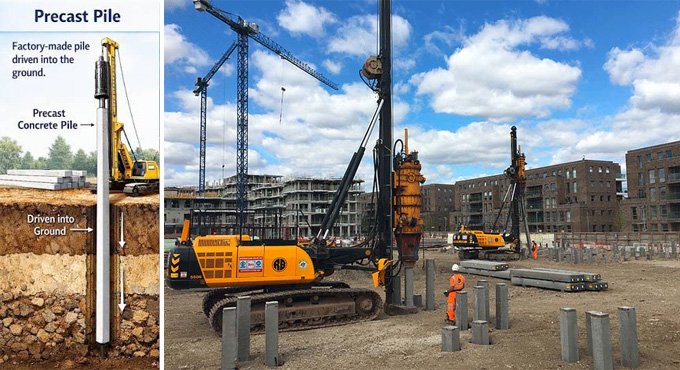
The precast concrete piles have been shaped in square, circular, rectangular or octagonal forms. These types of reinforced concrete piles have been manufactured and cured in a casting yard before it has been transported to the construction site. If space permits, the precast concrete piles can also be cast and cured in close proximity to the construction site. The diameter of the precast concrete piles ranges between 35 cm and 65 cm, and the length of the precast concrete piles ranges between 1.1 meters and 30 meters.
Discuss the different types of precast concrete piles used in the construction project
Driven Precast Concrete Piles
This type of precast concrete pile has been crafted from reinforced concrete in a casting yard. After achieving the required strength, the driven precast concrete piles are forcefully hammered into the soil with the help of the pile driver, thus helping to reach depths exceeding 40 meters.
The installation method of these precast piles helps to ensure that the pile achieves a secure and stable foundation, which makes it suitable for different construction applications.
Bored Precast Concrete Piles
These types of precast concrete piles have been manufactured with reinforced concrete in the casting yard. The installation process of the bored precast concrete piles involves a different approach from driven precast concrete piles. In this case, piles have been lowered into the pre-bored holes. This type of precast concrete has been used in cases where more controlled and precise placement of the piles has been required.
Learn about the advantages of using precast concrete piles in the construction project
Improved quality control
The precast concrete piles allow for better quality control than the on-site construction process. The precast concrete piles have been made with high-quality construction materials, which leads to achieving higher quality and consistency than site-cast concrete.
Speed up the construction process
The precast concrete piles have been manufactured in large quantities, which leads to speeding up the construction time and helps to shorten the project schedule. The installation of the precast concrete piles can be done more quickly, which helps to reduce the time required for the on-site assembly.
Providing long-term durability
The precast concrete piles are long-term durable and can resist environmental factors, including extreme weather conditions and chemical exposure. The precast concrete piles can also resist fire and have a long service life, which helps to minimise the requirement for frequent maintenance and repair processes.
Cost-effective nature
The precast concrete piles are cost-effective in the long run of the construction. The precast concrete pile requires less labour and equipments too install it at the construction site, which helps to reduce the overall construction project cost. In addition, the precast concrete piles help to achieve a high-quality finish, which can eliminate the requirement of additional finishing works, thus helping to save overall project time and costs.
Improving flexibility
The design of the precast concrete piles helps to meet the structural requirements of the piles; thus it can be used in different types of building structures and configurations. In addition, the precast concrete piles can also be customised in different sizes to match the specific design requirements of the construction project, thus helping to achieve greater flexibility in the design.
Improving construction site safety
The precast concrete piles have been manufactured in a controlled factory environment, which helps to improve the overall safety of the workers as compared to the on-site construction process. This process helps to improve the quality of the final product and reduces the risks of accidents and injuries at the construction site.
Reducing construction site disruption
The production of the precast concrete piles has been done off-site, which helps to minimise on-site construction and disruption to the surrounding area. This off-site production is beneficial in urban or densely populated areas, where minimising disruption is important.
Understanding the disadvantages of using precast concrete piles in construction work
Requiring transportation and installation equipments
The precast concrete piles are heavy and also require specialised equipment to transport and install them at the construction site. This heavy weight limits the use of the precast piles in certain construction methods, for example, crane placement, which leads to additional costs and logistical challenges.
Providing environmental impact
The production of the precast concrete piles requires a large amount of energy and also releases a huge amount of carbon dioxide into the atmosphere. The transportation process of the precast concrete piles leads to emissions of greenhouse gases, which have a significant impact on the environment.
Requiring special maintenance
The precast concrete pile requires special maintenance, for example, replacing the damaged elements or sealing the joints. In addition, the repair of the precast concrete piles can be more complex, and the repair process is more costly than on-site repairs to site-cast concrete.