NEWS | SOFTWARE | SHEET
RCC Dog-Legged Staircase Design: A Comprehensive Guide
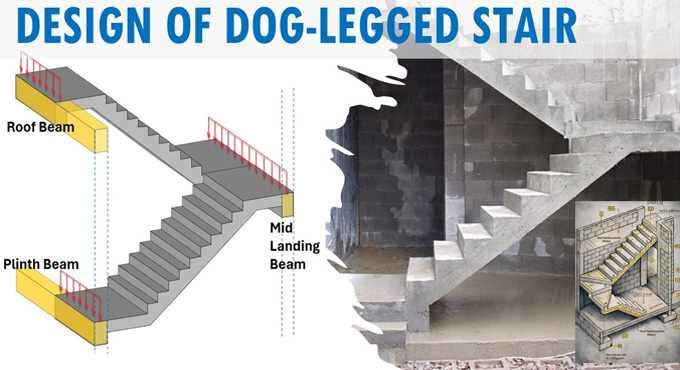
The RCC dog-legged staircase has been likened to a dog’s bent leg, which has become the popular choice for those spaces where the grand and sweeping staircases do not fit. The RCC dog-legged staircase is a compact and space-efficient staircase design, which features two parallel flights running in opposite directions and connected by a 180-degree turn at mid-landing. The RCC dog-legged staircase has been widely used in residential and commercial buildings as it can fit into small and rectangular spaces with no open spaces among the flights.
Discuss the key components of the RCC Dog-legged Staircase
Tread
The tread is the part of the staircase where the user steps. The tread part of the RCC dog-legged staircase is important as it helps to support an individual's weight when walking up or down the stairs. It needs to be ensured that the tread is wide enough to fit an individual’s foot comfortably while designing the staircase.
Riser
The riser is the vertical part of the RCC dog-legged staircase, which helps to separate each step into two treads. The riser part of the RCC dog-legged staircase helps to determine how each step is. The riser of the RCC dog-legged staircase helps to make climbing the stairs easy and comfortable.
Baluster
These are vertical pieces of the RCC dog-legged staircase, which help to connect the handrail of the staircase to the rest of the staircase. The baluster has been spaced out along the flights of the stairs, which acts as a barrier to prevent falls.
Newel post
The newel post refers to the large post of the RCC dog-legged staircase that has been seen at the beginning and end of that staircase. The newel post helps to provide structural support to the handrail and keep the handrail sturdy and secure.
Handrail
The handrail is that part of the RCC dog-legged staircase on which an individual can hold while going up or down the staircase. The handrail of the staircase runs along the length of the staircase, and it has been supported by the balusters and newel posts of that staircase. The right height and smoothness of the handrail are important to ensure the safety and comfort of the staircase.
Landing
The landing of the RCC dog-legged staircase refers to the flat area at the turning point between the two flights. The landing has been designed to break the continuous climb, which helps to provide a spot to rest, as well as helps to make the stairs safe by decreasing the number of continuous steps.
Pitch
The pitch of the RCC dog-legged staircase refers to the incline of the length of the staircase, which has been measured between the horizontal and the line of nosing.
Line of nosing
The line of nosing is the imaginary line that runs across the front edge of all the treads. The line of nosing of the RCC dog-legged staircase helps to design the staircase, and helps to make sure that all steps of the staircase are uniform and easy to climb.
Understanding the key advantages of the RCC Dog-legged Staircase
- The RCC dog-legged staircase has a simple and straightforward design, which has become popular for many settings.
- The RCC dog-legged staircase is perfectly fitted in small spaces.
- The drafting of this staircase design is simple because of its uncomplicated nature.
- The RCC dog-legged staircase offers efficient spacing, which enables more carpeting and helps to reduce waste.
- The RCC dog-legged staircase also enhances privacy as neither the top nor the bottom floor is usually visible from the top of the stairs.
Learn about the process of RCC Dog-legged Staircase design
Setting the assumptions for rise and tread
While designing the RCC dog-legged staircase, at first, the riser and tread have to be assumed properly.
Determining the width of the stairs
The width of the staircase should be divided by 2 to estimate the width for a single flight of the staircase.
Calculating the height of the flight
While designing the RCC dog-legged staircase, the height between the floors has been split in half.
Calculating the total space that has been occupied by the treads
In the next step, the total space occupied by the treads needs to be estimated.
Calculating the remaining space
After estimating the total spaces, the remaining space needs to be calculated by subtracting the tread occupied space from the total length of the stair hall.
Making a plan for landing
In the next step, the landing length should be assumed, and the remaining space should be estimated again to use as a passage or to adjust the length of the tread.
Discuss the staircase sheet
The staircase sheet is the Microsoft Excel tool that has been used to design and analyse the staircases. The staircase sheet helps to compute the key structural parameters, for example, the thickness of the slabs, the reinforcement requirements and load calculations on the basis of the input values.
Importance of the staircase sheet
- The staircase sheet enables the users to input dimensions of the staircases, such as the height of the riser, width of the tread, landing size, materials and the number of steps.
- The staircase sheet helps to calculate the required depth of the waist slab and reinforcement details of the staircase.
- The staircase sheet also helps to determine the structural loads on the staircase, including the live load, dead load and floor finish.