NEWS | SOFTWARE | SHEET
Understanding Retaining Walls and the Types of Retaining Walls Used in Construction
The retaining wall helps to hold the soil and maintain the ground at different levels on each side of the wall. Retaining walls are important in uneven terrain and hilly areas to prevent the erosion of the soil, help to stabilise the slope and help to make the land usable. The construction method of the retaining walls depends on the type of soil, the height of the walls, the expected load and also the presence of groundwater. A well-built retaining wall acts as a structural safeguard, which helps to improve the usability, visual appearance and safety of the area it supports.
Discuss the purpose of the retaining wall
The retaining wall has been used in the construction to support the soil where level differences exist. The main purpose of the retaining wall is to prevent the natural movement of the soil and also helps to maintain the terrain shape.
The retaining wall helps to protect the construction structure against landslides, erosion and slope failure. The retaining wall has been widely used in the construction process, which helps to create flat surfaces, thus making the space available for building structures, roads and landscaping. The retaining wall has also been used in railway, highway or irrigation projects to stabilise the embankments and helps to prevent the ground from interfering with the built structures. The retaining wall also contributes to the safety of the construction site and thus improves the usability of the land in unstable areas.
Learn about the process of constructing retaining walls
Conducting a site survey and finalising the design
While constructing the retaining walls, the contractor has to conduct a detailed survey to know the type of soil, slope conditions and level of the groundwater. Then, the design specifications have to be finalised on the basis of the engineering calculations and safety factors.
Preparing the site
The construction site should be prepared by cleaning vegetation, debris, and loose material, and then the foundation excavation needs to be done on the basis of the design depth and width.
Constructing the foundation structure
In the next step, a levelling course should be laid by using plain cement concrete or compacted gravel. It should be ensured that the foundation is wider than the wall base.
Reinforcement placement process
In the next step, the reinforcement bars need to be fixed as per the structural drawings. In this case, adequate cover blocks should be provided to prevent corrosion.
Shuttering process
The sturdy formwork needs to be erected to shape the retaining wall. This process helps to support the wet concrete until it gains strength.
Concrete pouring process
In this stage, the concrete is poured in layers; the concrete is vibrated thoroughly to remove air voids and finish the surface.
Installing a drainage system
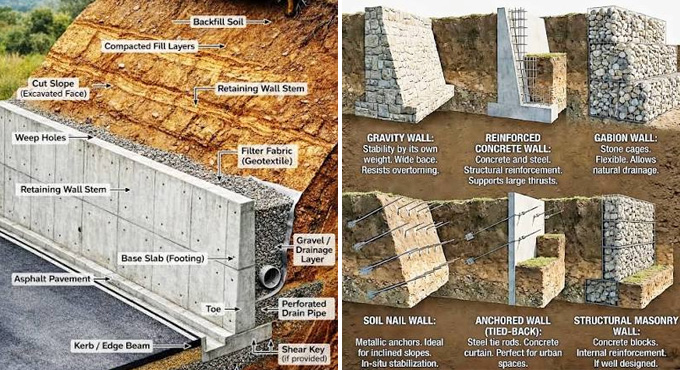
Weep holes need to be provided at regular intervals, which allow water to escape and reduce hydrostatic pressure.
Curing process
In the next step, the concrete should be kept moist for the recommended curing period, which helps to gain strength and prevent cracks in the structure.
Backfilling process
Backfill is required behind the wall, and it is done in layers by using the selected materials. These layers should be compacted properly to avoid settlement.
Inspection process
Protective coating, cladding or plaster should also be applied to make the wall more weather-resistant. Lastly, alignment, stability and drainage of the structure should be inspected carefully before handing over the structure.
Understand the different types of retaining walls
Gravity retaining walls
These types of retaining walls use the gravitational forces of their own weight, which helps to resist the earth pressure from the ground. This type of retaining wall helps to prevent sliding and toppling. The gravity retaining wall has been built with masonry, concrete, blocks, bricks, or mass cast in-situ concrete. This type of retaining wall has been designed to be wider at its base; thus, it can resist the higher lateral earth pressure at depth.
Embedded retaining walls
These types of retaining walls have been extended deeper than the excavation. These types of retaining wall have been used to form near-surface underground structures, for example, metro stations, basements, and car parks. In this type of retaining wall, additional support has been provided by internal propping.
Cantilever retaining walls
The cantilever retaining wall has been built using reinforced concrete along with an L-shaped, or inverted T-shaped, foundation. The cantilever retaining wall consists of a stem and a base slab. The stress on this retaining wall has been transferred onto the foundation, which helps to prevent toppling due to lateral earth pressure from the same soil mass.