NEWS | SOFTWARE | SHEET
Types of Stirrups used in Construction and their Applications
Stirrups refer to the most essential reinforcement components used in reinforced concrete structures. The stirrups have been designed to provide shear resistance, strength and stability to the columns and beam structures. The stirrups are the closed-loop steel reinforcements that have been involved in encircling the main longitudinal bars; thus, the longitudinal bars can be held strong in their place and protect themselves from buckling under compressive loads.
The stirrups also help to resist the shear forces that result in diagonal cracking and structural failure. In the case where the stirrups are not properly placed, the reinforced concrete members can be weakened over time; thus, the overall strength and durability of the construction structure can be impaired. The stirrups have been used in high-load-bearing structures, for example, skyscrapers, bridges, and earthquake-resistant building structures. The construction process of the stirrups should be done on the basis of the design codes and engineering standards to meet the structural safety requirements.
Discuss the different types of stirrups used in construction work
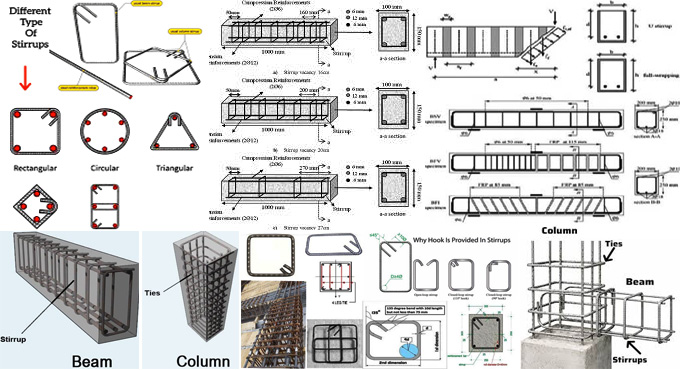
The stirrups are mainly closed or open stirrups, in which the closed stirrups have fully enclosed loops. These closed stirrups help to provide maximum shear resistance and confinement to the concrete structure. On the other hand, the open stirrups are basically the U-shaped stirrups that have been used in special cases, in which the closed stirrups are impractical. There are different types of closed and open stirrups, which are as follows:
Single-Legged Stirrups
The single-legged stirrups are the open stirrups, which have been designed to secure two rods. Due to their limited application, the single-legged stirrups have been used in small and specific areas in which minimal reinforcement is required.
Double-Legged Stirrups
The double-legged stirrups or two-legged stirrups are the closed stirrups, which are ideal for lintel construction and those construction structures which require reinforcement with at least four rods.
Four-Legged Stirrups
The four-legged stirrups are also closed stirrups, which consist of overlapping stirrups and partially enclose the rods. These types of stirrups help to ensure a strong hold on the central rods and help to reduce the risk of slippage.
Six-Legged Stirrups
These types of closed stirrups have been used to reinforce beams with eight bars, thus helping to offer robust support in high-load structures, like bridges. The design of this stirrup also helps to ensure that all eight rods are securely held in place and enhances the long-term durability of the structure.
Circular Stirrups
The circular stirrups are the open stirrups that have been used for round columns and help to provide stability in curved structures.
Helical Stirrups
These types of stirrups coil around the rods and help to provide superior grip and reinforcement for circular columns.
What are the key design considerations of stirrups in construction work?
While designing the stirrups, a proper design and installation process should be followed to ensure their effectiveness in the concrete structure. There are several factors that significantly influence the function of the stirrups in the construction structure, which are as follows:
Proper spacing
The stirrups should have the proper spacing to maintain the shear strength of the construction structure. If the stirrups are too far apart, there is a chance of developing cracks in the construction structure, which leads to the reduction of the load-bearing capacity of that construction structure and increases the chances of potential failure. On the other hand, if the stirrups are too close to each other, the construction costs will be increased unnecessarily and also impact the placement of the concrete. While determining the optimal stirrup spacing for a specific construction structure, the engineers should balance the shear resistance and economy.
Proper size
The size of the stirrups helps to determine the load-bearing capacity of the construction structure. The size of the stirrups should be based on the structural loads, column or beam dimensions and the shear strength requirements of the construction structure. In Indian construction structures, about 6 mm to 8 mm stirrups have been required in light load-bearing structures, 8 mm to 10 mm stirrups have been used in standard beams and columns, and 12 mm or larger stirrups have been used in high-rise building structures, bridges and heavy structures.
Anchorage to ensure full strength development
The anchorage helps to transfer the shear forces effectively to the concrete. If the stirrups are not anchored properly, then the stirrups may become ineffective, which leads to the reduction of the structural strength of the column and beams.
Adequate concrete cover
The concrete cover around the stirrups helps to protect the stirrups against corrosion, fire and any kind of environmental damage. If there is insufficient cover around the stirrups, they can be exposed, which can increase the risks of weakening, rusting and potential failure of the structure over time.
Understanding the significance of stirrups in construction projects
Improving the stability of the construction structure
The stirrups help to provide lateral support to the main reinforcement bars, thus helping to improve the overall stability of the construction structure.
Control cracks in the construction structure
Stirrups also help to limit the width and spread of cracks, thus, the stirrups help to maintain the structural integrity of the construction structure, as well as improving the appearance of the concrete elements.
Enhancing shear strength
The stirrups also enhance the shear strength of concrete members. The stirrups help to prevent sudden and catastrophic failure of the construction structure by distributing the shear stresses.
Involved in load distribution
The stirrups also help to evenly distribute the load of the construction structure, thus helping to reduce the stress concentration of that construction structure.
Confine concrete core
In the case of column structures, the stirrups help to confine the concrete core, thus helping to improve the comprehensive strength and ductility of the construction structure.
Improving the durability of the concrete structure
The stirrups can also control cracking in the construction structure, thus improving the overall structural performance of the construction structure and helping to achieve long-term durable building structures.
Preventing buckling of the bars
The stirrups have also been used to prevent the reinforcing bars from buckling under compression or tension.